The Onug Blog
Enterprise Cloud 2.0 Technology Solutions, Strategy and Use Cases
Subscribe


The work of enterprise IT operations to keep applications and services resilient and available has not fundamentally changed in the past 20 years. The escalation chains, the L1 teams, the bridge calls, the offshore outsourcing, all of it was built on a simple premise: when your tools and automation hit their limits, you throw people at the problem. It was the only option available until now. For decades, the work that overwhelmed IT operations wasn’t technically complex; it was relentless and context-dependent. Triaging ambiguous alerts,…

Despite massive investments in compute, most AI clusters operate at only 50–70% average GPU utilization during peak periods. This efficiency gap is rarely a failure of the silicon itself, most likely it is a failure of the infrastructure to function as a unified system. When AI workloads scale beyond a single node, the network becomes the dominant performance factor, often determining whether a cluster delivers linear scaling or collapses under communication overhead. To bridge this gap, organizations must move away from manually integrating disparate systems…

Automation and AIOps are central to modern IT infrastructure strategy, promising significant improvements in efficiency, accuracy, and velocity. Despite significant progress, many organizations struggle with serious automation lifecycle challenges, particularly across hybrid IT estates spanning cloud and on-premises infrastructure, including networks and data centers. AIOps faces an additional risk: hallucinations and trust failures. When an AI agent queries infrastructure state to make an autonomous decision, and the underlying data is stale, inconsistent, or incomplete, the model confidently acts on a false picture of reality. The…

Every few years, the enterprise technology industry gets consumed by a binary debate that turns out to be the wrong debate. Build vs. buy in AI infrastructure is this generation’s version. Right now, the strong headwinds are blowing clearly in one direction — but smart infrastructure leaders know the wind always shifts. The job is not to pick a side. The job is to build an organization that wins no matter which way it blows. The Current Gravity: Why Buy Is Winning Be honest about…

Network operations is entering a new phase: not just “AI for alerts,” but AI that can explain, recommend, and execute workflows across your existing tooling. The reason many teams are still hesitant is equally simple: the network is the business. When AI touches telemetry, configs, tickets, and change workflows, the fears are legitimate — and ignoring them is the fastest way to stall adoption. Fear #1: “If I feed AI my network data, I’ll leak something sensitive.” The challenge isn’t just employees pasting sensitive content…

We are at an inflection point. Enterprises are trapped between two uncomfortable realities: public AI services are convenient but risky, while private infrastructure is expensive and complex. But that equation is changing. This tension is already reshaping enterprise IT strategy—and over the next few years, it will trigger a fundamental restructuring of how organizations deploy artificial intelligence. The Public AI Problem: Control is the New Currency Today’s enterprises are forced into a precarious position with cloud-based AI services like Gemini, Claude, xAI, and OpenAI. These…

Enterprise networking is in the middle of a major transition. For decades, most data center networks were built as vertically integrated stacks, where hardware and network software were tightly coupled to a single vendor ecosystem. That model is increasingly misaligned with today’s reality: hybrid infrastructure, faster scaling cycles, and the need to automate operations end-to-end. This is why disaggregation has become a strategic direction for enterprise infrastructure teams. By decoupling the network operating system (NOS) from the underlying switching hardware, organizations gain flexibility in procurement,…

Somewhere in every networking team, someone has already said: “We should really look at SONiC.” …and someone else has replied: “We’re not a hyperscaler. This is not for us.” If that sounds familiar, this post is for you. I’ll walk through five common myths about SONiC and open-source networking — and how to approach them without betting the business. Myth 1: “Open-source NOS is only for hyperscalers.” The belief SONiC is a Microsoft thing. Hyperscalers can afford to experiment; enterprises can’t. Reality SONiC has quietly become the…

When you think of SONiC (Software for Open Networking in the Cloud), it’s often associated with hyperscalers—the giants in tech like Google and Microsoft that demand unparalleled scalability and customization in their network infrastructure. But what if I told you that SONiC is no longer just for hyperscalers? What if I told you that enterprises—yes, Fortune 500 companies, mid-sized businesses, even finance and telecom industries—are now tapping into the power of SONiC to transform their networks? Flexibility Through Choices One of SONiC’s strongest suits is…
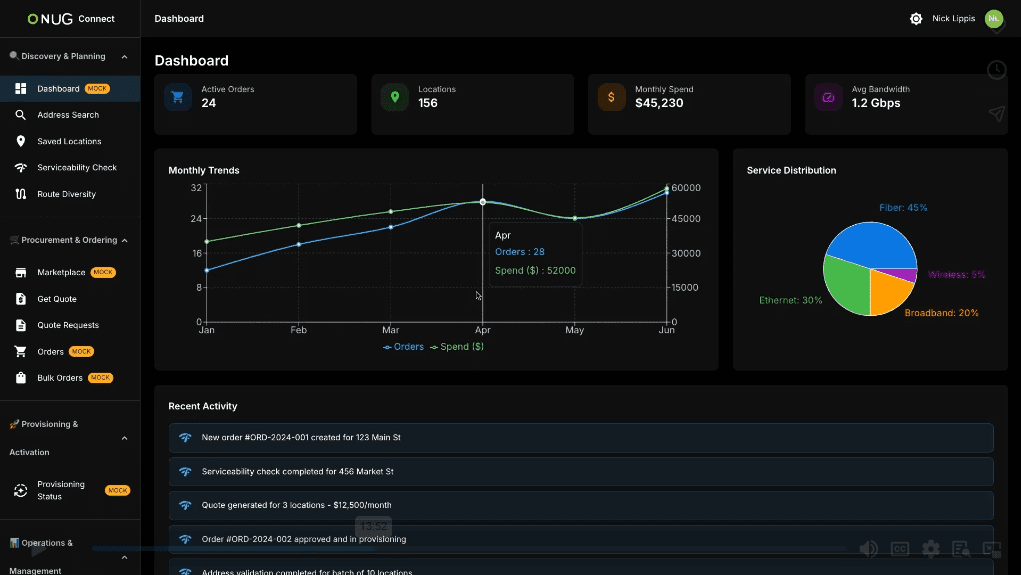
This is a summary of the AI Networking Summit – New York session moderated by Tony Farinacci, ONUG CTO and Managing Director, CTO, CISO, Distinguished Architect JPMorgan Chase (retired). This session introduces ONUG’s AI-Enabled WAN Connectivity API initiative: a collaborative, enterprise-driven effort to build an open API framework for automating WAN services procurement. The landscape of Wide Area Network (WAN) connectivity procurement has long been characterized by inefficiency, manual processes, and significant friction. For decades, businesses have grappled with archaic methods, often involving lengthy sales…