The $250 Billion Operating Model Problem
The work of enterprise IT operations to keep applications and services resilient and available has not fundamentally changed in the past 20 years. The escalation chains, the L1 teams, the bridge calls, the offshore outsourcing, all of it was built on a simple premise: when your tools and automation hit their limits, you throw people at the problem. It was the only option available until now.
For decades, the work that overwhelmed IT operations wasn’t technically complex; it was relentless and context-dependent. Triaging ambiguous alerts, correlating failures across siloed systems, and capturing the institutional knowledge that lived in engineers’ heads resisted automation entirely. Agentic AI can now handle all of it, reasoning through complexity the way a seasoned engineer would, not by following rules but by understanding context. For enterprise IT teams, that is not an incremental improvement. It is a redesign of the operating model from the ground up.
Rules solved 20% of the problem. Humans absorbed the rest.
Rules-based automation has long promised to solve the burden on IT ops teams. Enterprises invested heavily in structuring their observability data, updating their CMBDs, identifying known scenarios, and working cross-functionally to create stable conditions for automated workflows. But enterprise IT is too dynamic for rules to keep up. The data is never clean enough, the scenarios are never fully known, and the conditions are never stable for long.
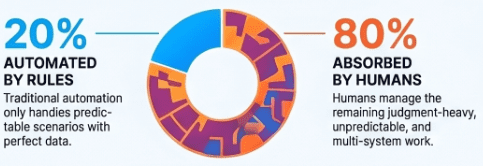
The result: rules automated roughly 20% of operational work. Humans absorbed the other 80%, the unpredictable, multi-system, judgment-driven work that could not be scripted. That gap became a permanent line item.
Enterprises spend an estimated $250 billion a year on human-driven IT operations, not because they want to, but because nothing else could handle the work that rules have left behind.
That cost shows up in operational teams running the same playbook year after year, in outsourcing arrangements where knowledge walks out the door with every rotation, and in the engineers who spend their careers firefighting instead of building.
From a data strategy to a knowledge strategy.
Agentic AI can reason through novel situations, fragmented workflows, and incomplete data. But an AI agent without operational context is not much more useful than a search engine. What makes the difference is the same thing that separates a seasoned engineer from a first-week hire: accumulated knowledge of the environment.
That knowledge lives across dozens of systems: incident history, change records, runbooks, service maps, and collaboration threads. The IT Knowledge Graph unifies all of it into a single layer, giving AI agents four types of context to reason across: situational (what is happening now), historical (what happened before), organizational (who owns what), and topological (how things connect).
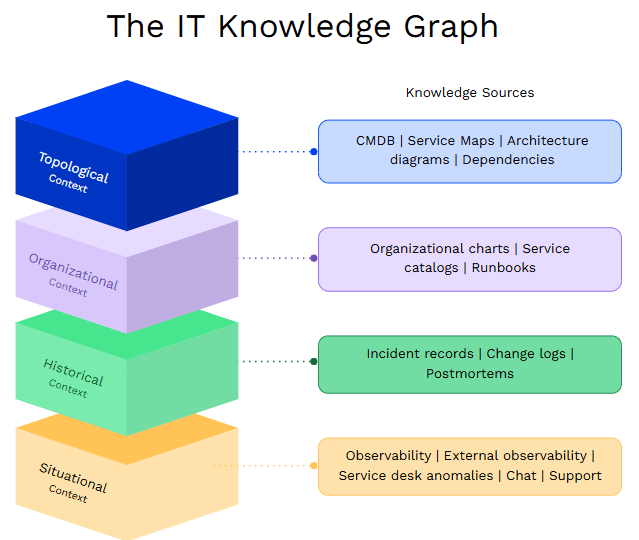
Critically, this does not require a clean CMDB or a data cleanup project to get started. The knowledge graph improves as a byproduct of daily use. Every incident resolved, every decision made, becomes an input that makes the next interaction smarter.
What early agentic AI adoption looks like in practice.
The shift is already underway at enterprises that have moved from rules to reasoning. The operating model that emerges looks very different: not hundreds of L1 operators and an offshore team, but a small group of SREs managing a fleet of agents that know the environment deeply. Not a bridge call to assemble the right people, but specialized agents arriving at a major incident with full context already loaded.
The LLM layer is commoditizing fast. What cannot be bought off the shelf is the proprietary knowledge of your own environment. That is the competitive moat. Early adopters are already seeing a median ROI of 430%, with payback in under a year.
If this is a problem your team is actively working through, BigPanda will be at the AI Networking Summit in Dallas. Stop by to see how agentic IT operations work in practice, and what it takes to move your environment from rules to reasoning.