Maximizing Value in a Volatile Storage Market
A significant shift has happened in supply and demand, creating challenges on multiple levels across data centers. Not only is the demand for power and floor space increasing, but there is the dramatic shift in costs driven by a massive increase in worldwide demand for silicon, particularly for memory and storage silicon, because of AI.
Gartner says that $2.52 trillion will be spent on AI in 2026, growing to $3.33 trillion in 2027¹. Major hyper-scalers alone are expected to spend $650 billion on AI and the technology to empower AI applications and workloads. The implication is that massive amounts of DRAM and Flash Storage are required to support these AI workloads.
Storage components in servers, however, have stretched component producers to the limit. Component Producers (of DRAM and SSDs/Flash) have stated that they are not building or bringing on more production. As a result, the cost per GB, TB, or PB of Flash storage capacity has skyrocketed.
This is challenging every IT budget worldwide! NAND flash costs doubled in the second half of 2025, a trend widely reported by major supply chain analysts and storage vendors. Flash wafer costs for 1TB QLC/TLC jumped by 25% in a single month this year. Overall, pricing has surged by as much as 300% since last year. Pricing volatility is expected to continue for the next 18-24 months.
In response, Infinidat, a Lenovo company, is helping enterprise customers to address this difficult situation. Luckily, there are options that should be considered to ameliorate these challenges – pricing volatility, increased power requirements, and constrained floor space.
Data center space:
With all the new server infrastructure, especially for the buildout of AI deployments, floor space is at a premium; there is pressure to find more ways to maximize and use existing floor tile space. Infinidat addresses this challenge by delivering a proven capability to consolidate workloads and the associated enterprise storage they run on, reducing floor space, power/cooling, and carbon footprint. (Read about why architecture matters: “Architecture Matters: 3 is way better than 2!”²).
A customer in the financial/insurance industry did a consolidation project, replacing 281 floor tiles of competitors’ arrays to just 61 with Infinidat’s solutions. At the same time, they increased the performance and availability of those workloads, resulting in over $10 million in savings in just OPEX in the first two years.
Power/Cooling:
New servers loaded with GPUs are gulping down every watt of power they can, stressing the supply/demand curve of every electrical utility. Combine it with additional highly optimized networking and other peripheral components ─ you can see why the demand adds up quickly. This significantly increases the operational expenses organizations face.
Consolidation has a dramatic impact on it. When you can power 10s of PBs of storage in a single rack and consolidate the footprint of several smaller arrays, costs decrease. As an example of how effective we can be, let’s assume we are consolidating three (3) arrays from a popular midrange architecture vendor. Using their public data on power, we can see a savings of 3 to 1!
Direct Cost of Flash/DRAM:
Enterprise storage solutions need DRAM, but there are options for rethinking the underlying storage devices in an array and optimizing data center storage.
Our industry has made an “all-in” shift to all-flash storage. For Infinidat, we, too, have industry acclaimed all-flash storage platforms, but, unlike many others, we have not abandoned our award-winning, high-performance hybrid storage solutions. That, coupled with our outstanding architecture and features such as SSA Express, gives Infinidat a set of unique capabilities that others don’t. Use the “Right Tool for the Job,” whether a hybrid array or an all-flash array.
The direct impact of supply chain instability and surging NAND pricing has, for the time being, eliminated the economic advantage of high-density QLC storage for many projects. While our all-flash arrays remain the performance leaders, Infinidat’s hybrid systems are built to deliver strong IOPS and latency metrics that are often faster than our rivals’ all-flash configurations.
While capacity varies depending on your specific configuration, Infinidat’s SSA Express allows you to isolate your most critical workloads on flash for top-tier performance, while significantly reducing costs by keeping general-purpose data on high-density disk. This is significant when you consider that, according to a Forbes article, the price of SSD capacity is over 20x HDD storage capacity.³ You can see upwards to a 35% price delta between all-flash and hybrid solutions.
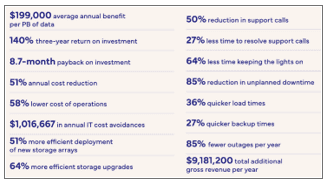
To watch Infinidat’s on-demand deep dive, “Maximize Value in a Volatile Storage Market,” click here.
¹ Gartner Press Release: Jan 15, 2026
² https://www.infinidat.com/en/blog/architecture-matters-3-way-better-2