Build vs. Buy in AI: Stop Asking the Wrong Question
Every few years, the enterprise technology industry gets consumed by a binary debate that turns out to be the wrong debate. Build vs. buy in AI infrastructure is this generation’s version. Right now, the strong headwinds are blowing clearly in one direction — but smart infrastructure leaders know the wind always shifts. The job is not to pick a side. The job is to build an organization that wins no matter which way it blows.
The Current Gravity: Why Buy Is Winning
Be honest about what the numbers say. In 2026, the overwhelming majority of enterprises are consuming AI through hyperscaler APIs — OpenAI, Anthropic, Google Gemini, xAI — and the reasons are not hard to find.
GPU economics are brutal. Acquiring, housing, powering, and cooling the H100 and H200 clusters required to run competitive large language models requires capital expenditure that most organizations cannot justify, particularly when utilization is uneven and the hardware itself risks obsolescence within 18 months as next-generation silicon arrives. Data center footprint and power capacity — two constraints that were afterthoughts a decade ago — have become genuine strategic limiters. Many enterprises simply do not have the floor space or the megawatts.
The talent problem compounds the hardware problem. The engineers capable of operating, fine-tuning, and scaling private AI stacks are among the most competed-for professionals in the labor market. Hiring even a small team with genuine capability requires compensation structures that rival the hyperscalers themselves.
And underlying all of it is the pace of innovation. The frontier of AI capability is moving faster than enterprise procurement cycles. Organizations that locked in private infrastructure bets 24 months ago are already managing technical debt against models that have been eclipsed by multiple generations of public advancement.
The case for buy is strong — but it has a shadow side that every board will eventually force you to confront.
The Shadow Side of Buy: Where Control Matters
Convenience has a cost. When your AI infrastructure lives entirely inside a hyperscaler’s stack, three risks compound over time.
Intellectual property leakage is the most immediate concern. Even with enterprise agreements and zero-training guarantees, the instinct to protect proprietary data — customer records, financial models, strategic documents, product IP — is rational. The moment sensitive context flows through a third-party inference endpoint, governance becomes a matter of contractual trust rather than technical certainty.
Lock-in is subtler but potentially more expensive. As AI becomes load-bearing infrastructure — embedded in workflows, decisions, and customer experiences — switching costs grow. Vendor pricing power grows with it. The token cost curves that look attractive in year one are renegotiated in year three from a position of dependency.
The deepest issue is strategic control. Organizations that own no part of their AI stack own none of their AI future. When a hyperscaler deprecates a model, shifts pricing, or makes a capability decision that conflicts with your roadmap, you have no leverage and no alternative.
The Pendulum Will Swing — It Always Does
Here is the pattern every infrastructure leader should recognize: technology markets rarely stay at one extreme. The open-source LLM ecosystem is maturing rapidly. Model compression and quantization are making capable inference achievable on more modest hardware. Specialized AI silicon from multiple vendors is driving GPU costs downward. New tooling is lowering the operational complexity of private deployment.
In 24 to 36 months, the calculus will look different. Some workloads that today justify public token consumption will cross a threshold — on cost, on latency, on regulatory pressure — where private or on-premises deployment becomes the clearly correct answer. The organizations positioned to execute that transition quickly will capture enormous competitive advantage. The ones still locked into pure-consumption models will be renegotiating from weakness.
The Real Mandate: Infrastructure That Supports Both
The strategic imperative for infrastructure teams is not to predict which model wins. It is to build the capability to execute either model — and to move between them as conditions change.
That means investing now in the architectural primitives that are strategy-agnostic: unified data layers and knowledge graphs that serve both private models and public APIs with equal fidelity; network fabrics designed for the latency and throughput profiles of AI workloads regardless of where inference runs; API abstraction layers that decouple application logic from model endpoints; and governance frameworks for data classification that define clearly which data can leave the perimeter and which cannot.
It also means hybrid and multi-cloud architectures are not a compromise — they are the destination. Running frontier reasoning through a hyperscaler API for general-purpose tasks while routing sensitive workloads to a private cluster is not a transitional state. It is the mature operating model that sophisticated enterprises are already converging on.
The winning infrastructure team does not pick a side in the build vs. buy debate. It makes both sides possible — and makes switching between them cheap.
Position to Win, Regardless of Which Way the Wind Blows
Build vs. buy is a question that will be asked and answered differently every 18 months for the foreseeable future. The infrastructure leaders who will be celebrated in five years are not the ones who called the current moment correctly. They are the ones who built organizations agile enough to respond to the next moment — and the one after that.
The AI world is not moving toward one infrastructure model. It is moving toward a hybrid, multi-cloud reality where the specific mix of public consumption and private operation is a continuous optimization, not a one-time decision. Get your data in order, build for portability, design for abstraction, and invest in the skills to operate across the spectrum. That is not a hedge. That is the strategy.
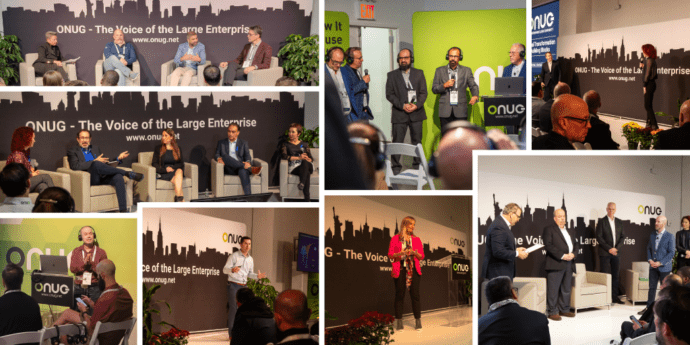
This blog is adapted from panel discussion themes at ONUG AI Networking Summit, Spring 2026. Opinions represent synthesized expert perspective across enterprise AI infrastructure practitioners.