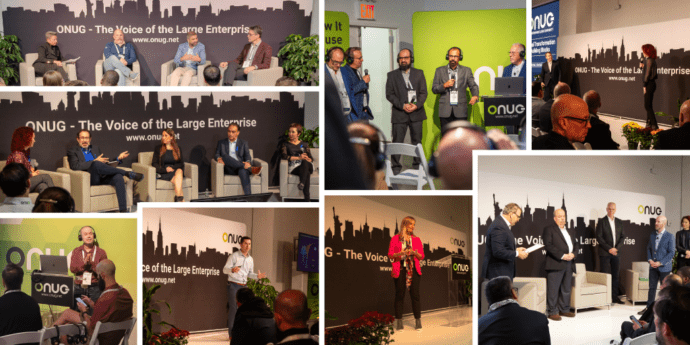
For decades, one of cybersecurity’s biggest challenges was finding vulnerabilities. AI may be about to reverse that problem. What happens when enterprises can suddenly find more vulnerabilities than their security and infrastructure teams can operationalize, test, patch, and mitigate? This question drove a discussion at the AI Networking Summit 2026 in Dallas that featured Mick Curry of Fidelity, John Feldmayer of eBay, Chris Moretti of Cigna Health, and Tom Gillis of Cisco. The conversation pointed to a fundamental shift in enterprise security: AI is beginning…
As enterprises move from experimenting with AI to deploying agents that can act, communicate, write code, and make decisions, the security conversation is changing too. For decades, enterprise security has focused largely on authenticating people, applications, and infrastructure. Agentic AI introduces something different: autonomous systems that can take action on behalf of the organization and interact with other agents, systems, and potentially other companies. That makes security about more than preventing access. Enterprises need to know what an agent is allowed to do, how far…

Enterprise AI adoption is moving faster than traditional technology planning cycles can support. New tools appear constantly, technology planning cycles are shrinking, and organizations are under pressure to deliver measurable value without compromising security, reliability, or governance. At the AI Networking Summit 2026 in Dallas, John Feldmeier, Vice President of Site Engineering and Information Technology at eBay, shared how the company is building an AI-enabled workplace while embedding governance from the beginning. The biggest takeaway: scaling enterprise AI is not primarily about deploying more tools….

Enterprise AI adoption is accelerating, but moving quickly is only part of the challenge. Organizations must also protect sensitive data, manage access, maintain visibility, and ensure new AI systems can operate securely at scale. During the AI Networking Summit 2026 in Frisco | Dallas, FedEx Freight leaders Michael Milligan and Prashanth Karne shared how the company is approaching this balance. Their central message: responsible AI governance should not slow innovation. Done well, it creates a repeatable path for scaling enterprise AI securely and confidently. What…

The AI infrastructure market just crossed a threshold. With GPU-backed debt now underwritten at scale, the constraint on AI compute growth is no longer capital — it is creditworthy enterprise demand. Analysts project AI debt financing will become a multi-trillion-dollar credit market by the end of the decade, second only to U.S. mortgages. Every dollar of that financing rests on one thing: enterprises willing to sign multi-year compute commitments. Those enterprises are the ONUG Community. For 15 years, ONUG has been where enterprise IT leaders…

The AI conversation has moved fast—but for most network and security engineers, the real work is just beginning. The AI Networking Summit in Frisco | Dallas isn’t about abstract ideas or distant futures. It’s about what happens when AI hits production environments, and what that actually means for the people responsible for keeping systems running, secure, and performant. Over the past two years, the Summit has grown rapidly—attendance alone has increased by nearly 90% — and that growth reflects something important: infrastructure teams are realizing that AI…

The work of enterprise IT operations to keep applications and services resilient and available has not fundamentally changed in the past 20 years. The escalation chains, the L1 teams, the bridge calls, the offshore outsourcing, all of it was built on a simple premise: when your tools and automation hit their limits, you throw people at the problem. It was the only option available until now. For decades, the work that overwhelmed IT operations wasn’t technically complex; it was relentless and context-dependent. Triaging ambiguous alerts,…
Every few years, the enterprise technology industry gets consumed by a binary debate that turns out to be the wrong debate. Build vs. buy in AI infrastructure is this generation’s version. Right now, the strong headwinds are blowing clearly in one direction — but smart infrastructure leaders know the wind always shifts. The job is not to pick a side. The job is to build an organization that wins no matter which way it blows. The Current Gravity: Why Buy Is Winning Be honest about…

We are at an inflection point. Enterprises are trapped between two uncomfortable realities: public AI services are convenient but risky, while private infrastructure is expensive and complex. But that equation is changing. This tension is already reshaping enterprise IT strategy—and over the next few years, it will trigger a fundamental restructuring of how organizations deploy artificial intelligence. The Public AI Problem: Control is the New Currency Today’s enterprises are forced into a precarious position with cloud-based AI services like Gemini, Claude, xAI, and OpenAI. These…

Enterprise networking is in the middle of a major transition. For decades, most data center networks were built as vertically integrated stacks, where hardware and network software were tightly coupled to a single vendor ecosystem. That model is increasingly misaligned with today’s reality: hybrid infrastructure, faster scaling cycles, and the need to automate operations end-to-end. This is why disaggregation has become a strategic direction for enterprise infrastructure teams. By decoupling the network operating system (NOS) from the underlying switching hardware, organizations gain flexibility in procurement,…