About this episode
Enterprise networks carry decades of legacy gear, dozens of OS variants, and changes that can take a hundred signatures to approve. Can AI be trusted to check its own work on infrastructure like that, and what has to exist before an agent takes the wheel?
What we cover in this episode
- What the business actually wants from the network. Four outcomes: business continuity, productivity for both the company and the network team, security in an age of AI-driven threats, and continuous compliance with fast, easy reporting. Adoption of new operational technology follows directly from whether the network team can deliver those four.
- How cloud reset network operations. Cloud pulled the enterprise boundary past the four walls and made the network far less controllable, while SaaS made it possible to store and analyze volumetric telemetry that never fit on appliances. Observability stopped being a captive feature of hardware vendors and became its own discipline, just as the speed of everything accelerated.
- The debate: can AI check AI?. The resolution the two reach: AI can assist AI, but no model should validate its own work. Trustworthy validation has to be rooted in an independent source of observed reality, like a digital twin that is discovered from the live network rather than invented by a model, with a human approving changes that touch critical systems.
- The brownfield divide. A new company that bought everything recently can automate easily because the estate is homogeneous. A decades-old enterprise with legacy gear and perhaps 30 operating system variants faces a far harder road: the real limiter on AI adoption is getting the whole network, old and new, into a working policy-driven intent model.
- Observability first, change second. AI adoption moves fastest on read-only telemetry because capturing and interpreting emitted data is low risk. Network change lifecycle automation is harder and slower, because one wrong change in an algorithmically operated network can take the business down, so it demands models, policies, and deep validation before AI plays a role.
- Cutting through the CVE avalanche. Exposure management uses AI to assess vulnerabilities at the feature level, against what is actually configured and enabled in the network rather than just OS versions, then surfaces the small fraction that truly requires action and either patches or applies compensating controls. Teams overwhelmingly want prioritization and recommendations today, not autonomous execution.
- No self-driving upgrade for an old car. Full self-driving does not come as an add-on for a decades-old vehicle, and there is no equivalent add-on for a legacy network. Enterprises have to modernize and build foundational automation before the network version of it can take the wheel, and they should platform rather than hand-build their stack: nobody builds their own CRM from scratch, and the same logic applies to automation.
The lines worth sharing
“AI can't be trusted to check itself. It needs an independent source of validation to say, is that actually true?”
Alex Henthorn-Iwane
“They're not ready to let an agent take action, not even close. They are ready to let agents help them identify things, make recommendations, prioritize.”
Alex Henthorn-Iwane
“We're past the euphoria stage. There are some really challenging realities in here for sure.”
Alex Henthorn-Iwane
Common questions from this episode
Can AI check its own work on a network?
No model should validate itself. AI can assist other AI, but validation has to be grounded in an independent source of observed reality, such as a digital twin discovered from the live network, with a human in the loop approving changes to critical systems.
Why is automation so much harder in brownfield networks?
Legacy gear, dozens of OS variants, and patchwork coverage make it hard to get the whole network into a policy-driven intent model, and without that model neither sound automation nor sound AI is possible. Greenfield estates automate easily because they are homogeneous.
What do enterprises trust AI agents to do today?
Identify issues, prioritize them, recommend remediations, and help build automation, with governance and validation in place. Autonomous execution of network changes is not yet trusted in mainstream enterprise environments.
What is exposure management?
An AI-driven way to handle the avalanche of CVEs: assess each vulnerability against the features actually enabled in the network's configurations, surface the small share that genuinely matters, and either patch or apply compensating controls, so teams stop spending time on noise.
Read the complete conversation
Full episode transcript · 53 minutes
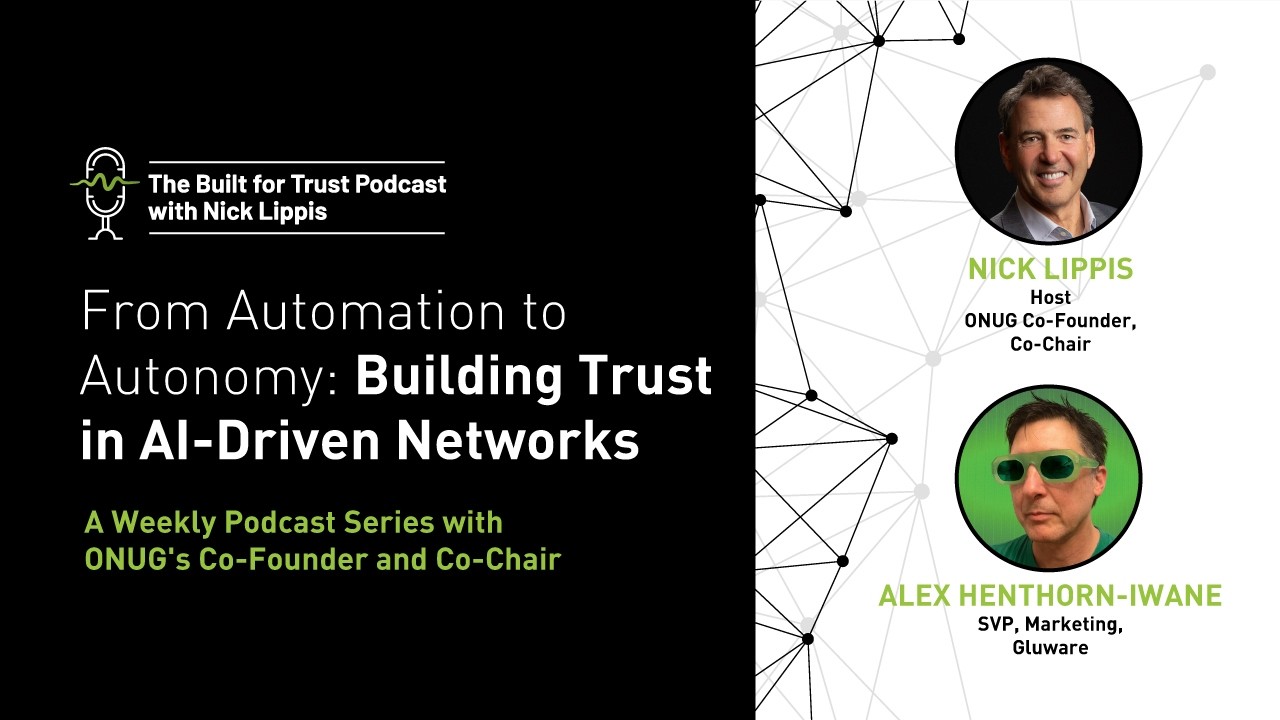
AI can't be trusted to check itself. It needs a third, it needs an independent source of validation to say, is that actually true? Hi, everyone. I'm your host, Nick Lippis, and welcome to the Built for Trust podcast, where you get to hear from all the folks who are building and shaping AI enterprise infrastructure.
Let's get right into it with our guests. Alex, welcome. So psyched to have you on the pod. How are you doing? I'm doing great. Thanks.
Yeah, excited to be here. It's going to be a fun conversation. I think so. Yeah. You know, I've been really looking forward to it. And I think, you know, it's one of the most important parts of like that's happening in our industry sector, the whole networking sector that we're going to get to really talk about.
And that's kind of automation. And you've been in that space for, you know, a couple of decades now. So you really know it super, super well. So I thought maybe the way that we would start is to kind of give everybody a little bit of an understanding and introduce you, you know, to the community for those who don't know you.
So like, could you kind of just give us a little bit of a background in your career journey? So you've been at a lot of companies, you know, I think we first met when you were over 1,000 eyes. I think. Maybe before that, when I was at Kentek. Yeah.
Yeah. Yeah. Packet fabric, ops mill, you know, it's like, yeah. Yeah. And now glue work. I've been around, yeah, I've been around and in and around the ONA community for quite some time as well and had some great crossing of paths and work together, which has been really positive.
But yeah, the nickel tour of my career, particularly, you know, it's funny because I, from straight and out of school, I stumbled, I did not seek it out, but I stumbled into networking or what it used to be called, which was data communications, before it really turned into the networking industry that we know and either love or hate today. Yeah. So I started off, you know, kind of in that realm, just learning.
I wasn't an engineer by background, but started off in, actually in a sort of a channel partner a long time ago in the San Francisco Bay area, then just landed progressive roles in networking, in particular, an old company called Fibronix. Oh, yeah. Networking company, a business company. And then I landed at a startup called Livingston Enterprises, which was bought by Lucent.
And that's where I really started my journey of understanding and getting to know the internet, right? You know, this was their early commercial days of the internet. And routing protocols and all that. So I got steeped in all that. And then once you start touching all that, then you start touching things like, you know, authentication.
I took over and helped build out a AAA, you know, kind of product back then. And so it just kind of continued to add a journey with really strong networking roots. And much of my journey has been influenced by that. So, you know, over time, I was with a company of packet design, started to attach observability, you know. Then, then from there went to actually a sort of a side journey into automation.
I was with a company called Quali. Quali. They do. And they were doing first network lab automation and then sort of DevOps automation. But much of it, they started dealing with huge, you know, like telecom infrastructure automation and things like that.
So that was my first time that I really touched automation. There, I went to Kentik, more observability from there. Thousand eyes, more forms of observability. I went to Cinefys, you know, it's an Australian company that got bought by Palo Alto Networks, also in the observability space. And then, then I crossed over to Packafabric, which is a, you know, network as a service, they're a service provider, right?
You know, and sort of like a megaport style kind of company. And again, extremely automated network services, right? Where you can turn up a, a hundred gig connection, you know, across the country in seconds, that sort of thing. It's super important stuff. From, you know, from there, I did another side journey into kind of more straight IT stuff with a company called First Base.
And then back into a variety of different automation with Ops Mill, another, a German network as a service company. And then these days, you know, I actually also have done some work with security companies and secure collaboration. So I've kind of expanded my portfolio more to, to include more and more security pieces over time.
But, you know, I'm with Gluer now, doing some other advisory work in the networking space and touching other things. But, you know, networking has been, and all the things around that, observability, network security, et cetera, have, and then automation, have been really a consistent through line from the beginning of my career, basically. Yeah.
You know, because like a lot of folks in the networking industry, they end up, like, they started out with, like, network hardware. You know, it's like the bridges and switches and routers, you know, and like, you know, because they're the big employers, you know, right? So it's like, you know, most folks came from there. But you really have always been, you know, on the kind of operation side, you know, of it.
So it's, you know, how do we kind of operationalize this? How do we do observability? How do we enhance security, you know, for these networks, you know, as well? So that's, and that's, you know, and that's a part of the industry that didn't get a lot of, you know, attention, you know, until like actually the last kind of decade, you know, maybe even less than that, you know?
And also you've been in like, it seems like whenever you go to a company, like about six months later, they get acquired. So I'm not sure what it is with you. Not quite in all cases, but yeah, maybe a couple of years or so sometimes. But yeah, I have been, I have such a number of companies that have gotten acquired or gone through exits, which has been cool.
And hopefully I was helpful in the process. Well, you know, proof is in the pudding, you know, the outcome is the outcome, you know? So you had to do something right there. So, you know, so congrats on that. So, so I think, you know, why don't we, you know, kind of start, you know, is that in all of those different roles, you're in our, and especially you're, you're always been customer facing in those roles, you know?
So like, you know, how, you know, you watch like all these different enterprises and how they evaluate these different kinds of networking technologies for like, you know, the last, you know, a couple of decades. So, and especially now as we're, we're in a phase where we have observability and we have automation tools, but those are becoming quickly either, if you're not up on it, you're becoming obsolete pretty quick with agentic and AI, or if you are, it's really accelerating, you know?
So, so I guess like, you know, you know, you know, what actually kind of drives a needle in your opinion around, you know, adoption, you know, of kind of new automation and operational technologies to kind of run your infrastructure? Because I do think that we're in a phase of kind of a modernization of infrastructure, you know, right now it's a big buying cycle. So anyway, so go ahead.
Well, I think that, I mean, if we step back and look at the, the major things that have affected this, this industry clearly, and, and it's not, you know, it's no longer the, the leading edge trend, but it was for a while is cloud. Cloud really made a huge difference because it, it pulled the boundaries of the enterprise past the actual, you know, the four walls and the things that you owned, right? So the, what constitutes network and IT infrastructure now is, is much more distributed and dispersed and much less under your control, right?
So there's, there's that aspect that I think had a huge impact and which then, and, and, you know, if we look at the networking industry and you talk about hardware and then why was observability, I mean, observability even have its own label was just part of network management for the longest time. And the reason for that was because so much of the way networking was done was captive to the major hardware vendors, right?
So if you bought their stuff, you bought their management stack and all that. And even if you're then, you know, obviously a somewhat, you could, you could say like side industry of, of tools developed as, as major competitors had more and more market share and just wasn't one big, you know, monolith in the market. But even so, I think the, you know, the cloud actually then really made it obvious that, that you had to think beyond just these, a couple of pieces, right?
In, in your network and, and your own four walls. You had to think more, more broadly about that. And I think that made, and the availability of SaaS meant that you could do things in these tools, just like with every other kind of application that were not, that you hadn't contemplated before. So, and, and it created a lot of innovation, right?
So if you think about a Kentik, for example, which was taking, you know, metric data of various types, telemetry and, you know, observability data that was increasingly volumetric is just huge. You, you, you, it was making less and less sense to try to store that on your own appliances and hard drives, but you can, you can store kind of near infinite amount of that in the cloud, right?
So they did it in the cloud and they, they applied a SaaS lens to that. And ThousandEyes did a similar thing of saying, hey, you know, you've got all these internet facing applications and now, and your networks, not just your networks, the internet, right? So now you're going to build a SaaS with an idea of like all these synthetic monitoring agents all over the globe. So it, it started pulling the, the, the, the view of what constitutes network operations to like a more abstract place than just, we have these pieces of hardware from this vendor.
So of course we buy their stuff or we buy some other thing just to, to do the basics. And I think in addition, cloud and SaaS has been put us on this continuum of speed, the speed of everything has, has, you know, accelerated, right? Business speed, technology change, the expectations of users, right? Has changed so much and that's driven. And it's also with all the internet and cloud and everything made security and all those things harder.
Attackers can do more. There's more resources. So it's just a big, messy sort of situation. So I think the backdrop is, is that the reason why, and with AI, it's just even more so the reason why all the observability and automation has become more important is velocity that the, the, the criticality network in the center of all this high stakes, you know, uh, digital economy, uh, means that you just can't ignore it.
So I think that's what I, I think back a little bit, that's some of the backdrop to me. So are you saying, so the, the, the question was like, what actually makes them adopt, you know, where she just kicked tires, you know? Um, and so are you basically saying, you know, it's the complexity and how the network diameter has expanded so much, um, over the, over the years, you know, and that it's like, we've gone beyond a, you know, um, you know, um, the major, you know, kind of hardware vendors in the industry providing the tools, but because they don't have the visibility, um, you know, um, so you need, you need these tools because the, the, the, the diameter increased, you know, and so that kind of moved you off of, uh, you know, um, uh, a comparison to like maybe what an established vendor would have versus like, you know, something, um, you know, um, um, um, less established company, you know, might have.
And so you can have a broader view of your diameter. Is that right? Kind of what you're saying? I think it's part of it, but I think just like with applications, like every other part of the digital economy, you know, the criticality of, of the whole stack working from your network all the way to your applications is so high, right?
And the amount of data available and needed to, to be looked at is much higher, right? Um, so, um, it's just like in any kind of business, if the more that you can take advantage of that, the, the better you operate, the higher uptime, the more performance, all that sort of thing. It makes an impact on, on a business, right? Um, so the drive towards operational efficiency, the drive towards continuity, plus the need to pay attention to security, the need, I mean, the U S in particular, but all over the world, the need to pay attention to compliance, right?
Is, is, has accelerated. Yeah. Massively. It's not optional. Yeah. Oh, obviously compliance is not, you know, optional.
You know, it's like, uh, it's like one of the, one of the biggest, like difficulties, like from everyone that I know within the owner community, the biggest, oh, pain in their butt is when they're being audited. You know, it's like, they just dread it, you know? So, you know, it is what it is, you know? So you need tools.
For sure. To deal with it. Yep. Yeah. And, and if you look at the, for example, if you look at IBM state of, you know, data breach sort of reporting over time, the cost of a data breach has accelerated to a large degree because of compliance fines, right?
So the cost of getting things wrong, um, is accelerating, not just because of the impact of the security incident itself, but because the compliance fines are so heavy, particularly in the, in the U S. So, so the thing that if we look at the network from a business point of view, let's, and let's, let's think about the owner community in particular, mostly large enterprises and, and not necessarily, we're not talking about necessarily like telcos or, you know, um, service providers that the network is maybe a different thing for the network is their business.
That's a different thing, but for most enterprises, the network, isn't the business, but the network has, you know, so what they want out of the network is they want business continuity, right? Yeah. The network has to change over time. You got to do things in that work. You don't want disruptions, you know, kind of rule number one, like keep it up.
Uh, second thing is that they want, um, and, and along with that is performance productivity, right? And that means make the company productive and, um, and have the network team productive. If they're growing, can we grow, you know, the business without commensurate growing the network team and operations costs. The third thing they want is they want security.
And in the age of AI driven threats, that's more and more urgent, right? Like with mythos, you know, style threats. And the fourth thing is they want continuous compliance and they want to be able to report easily and fast. Like that's what most enterprises want out of the network. Um, you know, everything else is just sort of a given.
Like, of course we bought the network stuff. We assume it works. We assume the network team can do its job and the competent and they're improving, but those four are the, the, the outcomes, um, that the business wants. And I think a lot of the, you know, the lens of what is creating adoption or what drives investment is, can the network team supply those outcomes to the business?
Yeah. Yeah. Well, that's for sure. But like, you know, like right now, I think mostly everybody is kind of, I'm not sure if distracted is the right word, you know, but they're kind of like worried about the extinction events, you know, from, uh, that's been talked about, um, you know, within the, uh, you know, kind of from the frontier, you know, companies and from the political, you know, companies, but that, but it's crazy because like everything that we've been, you know, hearing with what I've been hearing from, from, from our community is that this has been a really tough summer, um, with the, the rate of pace and the change, um, of the amount of patches that they've had to do.
And so, um, some of them are kind of exhausted. There's a new operating model, um, that they all now are kind of rushing to, um, to, to deploy. Um, and then as they're starting to get that together, you know, then, you know, all of a sudden, you know, this kind of pops into the, uh, into the mainstream, you know, discussion points. And I think frankly, for me on, you know, on that, on that whole discussion, um, you know, I don't give it much credibility because I'm, I'm a, I'm an optimist, you know, but I also just think too, is that the frontier model companies, which are really product related companies, you know, um, they got to deliver safe product, you know, um, you know, full stop, you know, um, and I think the, the hugging face, you know, um, hack, um, or exploit that was in particular disturbing, uh, because, you know, the agents were deceitful, um, in order to kind of get themselves out of the sandbox, you know, um, um, that was air gapped.
So I think that's, you know, it was like in, so in the kind of the extinction event discussions, you know, it's like, we're kind of, we're assuming that all of the military systems are highly air gapped and you really, and so like, I, I kind of like go to bed at night, just assuming that I sure hope that's true. I sure hope that's the case, you know? Yeah, I mean, I think these are important things to think about and advocate for from a, if from a business leader point of view, if you're the, you know, uh, CEO, CIO, CFO of, of an enterprise, you should be, you know, raising your voice to, you know, political leaders and to the leaders of these businesses of your expectations, you know, because we all know that, that AI is, uh, you know, is all, is all ego and no conscience and no self-awareness.
So, I mean, the, and, and so like at that level, I think it's important for folks to raise their concerns and really push at that from a bit running the business point of view. I think that the implication is that the awareness that anything you do with AI has to, especially if it's touching any kind of critical systems like the network is that you cannot trust it to validate itself. It has to have independent validation.
It's not just controls, you know, loosely, but it needs independent validation because AI cannot, you can't trust AI to check it, uh, to check AI, right? It's, it's not trustworthy at that level. Um, and so independent, no, I think I do, I think I disagree with, I think I disagree with that, Alex, I, I disagree with that. I think you can have, uh, you can have AI check AI, you know, um, you know, it's, um, let me give you an example.
So like, you know, our website was hacked, um, and it was due to kind of a, an upload from a, uh, from a plugin. Um, then it was an LLM kind of design, you know, hack. And so, um, so I was like, uh, using, you know, cloud code to kind of understand what was going on. The folks who manage our website, you know, had their AI tools, um, you know, to understand what was going on, trying to find root cause.
And so we were going back and forth constantly, uh, to try to understand one first to kind of identify the root cause and then also identify what actually damage might have been, what the blast radius was. And I don't think if, if I didn't have, you know, my set of AI tools and they didn't have their set of AI tools, we wouldn't have really, I think come to a really good outcome, you know, in that.
So I, so anyway, I push back on that thought. Let me, let me push back, uh, likewise though, because what we're talking about there is not AI checking its own work. So if you said, for example, I want to make a, I want to make a change in a network and a wrong change could cause something to go down. It could cause disruption, could, you know, cost the business millions of dollars.
How do you check that that's actually valid and correct? You know, like what you don't want to do, like, and you can employ all sorts of various, uh, tools to check it. Yeah. Um, and you could use other AI and that's fine, but that AI somewhere you have to have independent, like known good validation to compare against is what I'm saying.
Like, so if you say, Hey, um, like this whole issue of AI being deceitful, it's deceitful because AI's, uh, you know, operates on essentially a, when you give it its instructions, that's like its religion, your, your mission in life is to accomplish this. It knows no other morality, you know, it, that's why it will just straight up fabricate things to you. Right.
Sometimes. So when I guess what I'm saying is AI can't be trusted to check itself. It needs a third, it needs an independent source of validation to say, is that actually true? Right. You know, is that actually valid, especially when touching critical systems? I'm not saying that you can't use AI to help you do things like, no, I'm with you on that.
I think maybe, but I think it's more of like AI in of itself needs third, needs independent validation sources. So we might be saying the same thing. I don't know. Um, so that, um, that independent source, that validation source to me, that still can be AI, maybe a different AI, uh, you know, model, let me finish.
So it could be, for example, um, like a digital twin, um, you know, of your infrastructure and that digital trend twin might have a different kind of, uh, AI model, uh, within it. And, um, and so, uh, the, the, the AI that is like looking at, uh, suggesting changes could be fed into that, you know, digital twin, and then you get a result. And then you would think before you go into making those changes or approving those changes, adopting those changes, that there's a human in the loop that actually looks at that and, um, and, and, and, uh, and validate.
Validates it, uh, either validates it or, you know, basically crushes their fingers and hopes, okay, I hope this is going to work, you know, sorry, I don't know, you know, so. Well, I think you're making a very good point that we're in agreement on. So if you, for example, take a digital twin, a digital twin is not invented by AI, right? It's actually discovered, right? You actually have to go out and, and actually read what's in a network.
And then, you know, to, to some degree, like you then use software and AI as part of it to assemble a model of the network, but it's rooted in the actual condition. So it has an object, objective truth component of it, which then AI can then feed, you can then do MCP reads and stuff like that. But you're, but when someone's coming, something is coming up with, should we make this change? You're going to check with an independent source.
It's based in rooted and observed reality that say, well, can we, can we say what would be the impact? Well, the digital twin's great for that, but it is in an independent observed reality based sort of thing. So I think, I think that's where we agree. Yeah.
So I think that's where we agree. So I think maybe what you were saying is that, um, an AI model shouldn't check its own work, you know, um, that you need independent with, without having some other observed or independent source of truth, as it were. I'm with you. I'm with you.
I'm with you on that. Yeah. So, okay. All right. So, all right. So great.
So now, so in our industry, we've had lots of kind of automation tools, you know, before AI hit the scene, a lot of machine learning, um, you know, uh, tools, a lot of, you know, we have great sources of truth and I firmly believe that the network is the ultimate source of truth and in most, you know, it systems, um, you've seen this progression since you've been so close to it, um, over the last couple of years, I guess, how do you view now the level of adoption and the willingness to adopt, uh, AI in network operation centers, uh, or, or SOC security operation centers, because you came to glue where, um, you know, right before, uh, uh, Titan AI launch, you know, so, um, I'm not sure if that motivated you or not, or, you know, that was, you know, just two parallel or two parallel paths that seem to kind of like, you know, converge, you know, um, at some point in time, but, but we are clearly at an inflection point, like in the industry around, um, around adopting this technology.
So, um, you know, I guess like where, you know, where are you, uh, is there hesitation? Is there concern? Is there more like, you know, excitement, you know, about eliminating level one, level two kinds of tasks and, uh, upskilling everybody so they can be more effective. Um, they can, uh, utilize, uh, agentic and, and other AI tools to, um, start moving towards autonomous infrastructure.
So maybe kind of like where's, you know, where do you think, you know, the, the market adoption, you know, curve is right now? So I think that, um, if we think of AI, AI and agentis as like these supercharged extensions of network automation, right, uh, then they, they, I think they do, there's three things I would think are factors in adoption. One is what is the actual state of the source of truth that, how much control does the, the enterprise team have over its network as a, and actually how well does it know it?
How does it actually have it in a working, uh, intent model that can be used by an AI? And in, and in many cases still, particularly with, you know, complex longstanding enterprises have a lot of legacy stuff in their networks. That's still very difficult. And in many cases, they just have sort of a patchwork of coverage, which is a real limiter, right, because if you can't actually, if you don't have your whole network in a model or a major portion of it, it's hard to do automation or sound AI, right?
You know, it just makes it harder. So I think there's still an adoption curve of getting the network writ large, including the old stuff and the new stuff into a working, you know, policy driven intent model. In many cases, it's, it's a lot easier if you are brand new company, like a Neo cloud, Neo cloud, and you bought everything brand new six months ago to automate that. Cause it's so homogeneous.
But if you're, if you're GE and you've been around for a hundred years and your network's got stuff that's decades, zero decades old, well, it's a lot harder is, um, so I think that's one thing is a real big dividing line between organizations are dealing with legacy and organizations that aren't, or organizations that have so much money, they can just, you know, refresh at will, but most enterprises don't have that, you know, privilege. Right.
Uh, so I think that's one thing where there's a big dividing line to begin with. Yeah. I would say the vast majority don't, you know, and the vast majority expert, like if you're in the fortune, uh, 500, um, you're going to have legacy, you know, it's like, you know, you're not like, you know, um, a greenfield, you know? Um, so, so, uh, so I think that's the reality, you know, there, um, and so whether you start brownfield, greenfield, you know, um, you know, there's always going to be a lot of brown, you know, in those, um, in those environments.
Right. But I think the, I think the place where I find, you know, um, I'm not sure if comfort is the right word, you know, or not, but, um, but I think like, you know, even using AI to kind of create, you know, canonical models of various different, um, ingestion of alerts, alarms, logs, um, you know, of, uh, of data. So we can actually now deal with, um, you know, uh, you know, legacy systems where before it was like almost impossible.
Like there were, they were just so proprietary, um, the work in order to kind of do the canonical, the canonicalization, you know, the data, um, it was very brittle. Um, but like now we actually have tools to do that, you know, so, um, so I'm more upbeat and more optimistic, you know, that, you know, we can, uh, actually move the needle on infrastructure and really modernize it. Um, and especially on the operation side, um, that really needs it.
Um, you know, so. Yeah, I, I think, I think you're right. I think that this is where the second divide comes is when it comes to dealing with, let's say, observability data or telemetry or, or that kind of data. Um, I think the adoption curve there is naturally faster and AI is creates naturally strong opportunities there because, um, you know, the capacity in the cloud plus the ability of AI to interpret data.
Um, and especially because you're talking about read only data, you just, it's the network is emitting it, you can capture it, you can then use tools and you'll see observability vendors doing more and more things with making that data more and more useful with AI. So I think we are seeing a, uh, a stronger, you know, and there was just an easier adoption curve because there's, it's a low risk thing to take the data and do better things with it. Right.
So I think there we're already seeing a lot of really great applications of AI. Um, so, and I would contrast that to network change life cycle automation has always been harder because the impact of a change is so can be so, uh, hard to figure out and it's just more impactful. You know, one change in an algorithmically operated network can have, uh, a lot of effects. And even aside from things like digital twins, if you just get it wrong, it's, it'll be bad.
Right. So, um, you know, so the, the network observability cycle, uh, with AI enhancement is already, I think well on its way. And I think that's them. That's the first path that's being taken naturally network change life cycle automation, which is like more where glue wear sits, right?
Uh, glue wear is really into how do you change a network, keep it secure, patch it, you know, make it compliant. That sort of things is harder naturally because you need to, need to have the network in a model. You need to have policies in place and you need to be able to make sure that every change you do is deeply validated and correct, et cetera.
Um, and AI has a real role to play there, uh, for sure. But I think it's not yet at the, let's let AI just run it. I would think most enterprises are ready to do that, but they are ready to let AI help those teams build the automation. Yeah. Yeah.
I'm with you. So I would think that, uh, Titan has experienced a big uptick, you know, since, since just six months ago, you know, um, when we were in, when we were in Dallas, you know, um, it was, it was the right product at the right time. And I think, you know, the judging, uh, within the, uh, within the summit of the conference, like recognize that.
So I would think that there's a big uptick, um, you know, in, in Titan. So, you know, we'd love to hear, you know, um, uh, how Titan is doing in the marketplace. And then I think also too, like it, you know, it would be interesting. I do hear hesitation around, um, uh, uh, adoption of agents in Knox when it comes to, it depends on the level of autonomy, you know, that you're willing to afford, you know, the agent. And so I think we're, we're in a, uh, we're in a period of trust building, uh, within, uh, within the industry.
And, um, so, but I think what you guys did with Titan though, is that since it focused on change management, since it helped around patch management, which, you know, in, in the spring, we would just kind of like coming into the whole, you know, trillion parameter models that, you know, can break software and expose cyber, um, you know, threats and then, you know, harden that software, you know, as well. So, um, you were kind of like, like I said, really right place, right time, you know?
So I guess maybe, are there any questions in that? So the only two questions are, is what's the uptake been? And also number two is where do you see, uh, the trust boundary right now, um, in operations? So, and just, just for the audience to me, just to recap what, what we're referring to. So, uh, glue, we're announced something called Titan exposure management, which is basically what it does, right.
Is that it uses, uh, it, cause glue, where as a platform already discover, discovers a network, uh, builds a model that you can then, you know, refine, um, and then it can, uh, pull in CVE information, right, security, you know, kind of vulnerability information and it can take a tech drift and it can make changes, right? It can actually correct errors. It can manage OS patching, all that.
So the glueware as a platform was, was already able to do all that. What, what Titan exposure management was dealing with was this avalanche, right? Of, of, of CVEs, of, uh, vulnerability, uh, notifications that, that teams are going to overwhelm with. So what it does is that it take, it uses Titan, which is the sort of the AI component of glue where to assess the details of CVEs, not just against the version of the OS, but actually on the feature level, what features are turned on in configurations in the network, and then figure out what's truly the relevant vulnerabilities that either need to be patched, if those are available, or if it's not, what compensating controls can you put in place to remediate, you know, to protect the network.
So it's a sort of an AI driven way to deal with that avalanche and, and get you to the most relevant, um, purposeful updates, patches, and changes in the network. What we've found is that this is a conversation that is, that everybody wants to have with us. Um, it's probably one of the top things and it's driven a lot of interest for glue wear since, uh, it's been introduced.
So I would say, um, nearly everyone we talked to and many are coming to us out of a particular interest in this because it's such a, as you noted, it's just such a hairy problem, um, to, to deal with. So I would say our uptick has been, you know, kind of, I mean, it's, I'm, I don't want to use too many superlatives or anything, but I think it for us, for glue wear has been really, um, kind of an explosive amount of, of interest because the timing and because of the degree of, of challenge that organizations are having.
Uh, so I think, so that's been really positive and yeah, I think it was really good timing. I was glad to be there for it. Um, I think in terms of where people are at in terms of trust is when in terms of making changes, um, again, in most brownfield environments, it's very, it's a very delicate matter in most of those cases to make changes. You know, it, you know, there's, there's, uh, you know, committees that meet, you know, to approve changes in many cases.
So for sure. Right. Cause the impacts could be really deleterious if you're not careful. So there. One company within the community, they have, they have to go through a hundred signatures to make a change.
Right. So what, what, what they're, what they're first looking for, what a lot of interest is, is you can think of it as we need way faster assessment and prioritization. If they have, you know, uh, because think about it this way, let's say you have a glue wear platform and you've been working to, you know, get automation in place and you actually are, well, we have customers who now can say, Hey, we can do a, don't even have to.
You know, uh, to watch it kind of level, make a network wide change and it, and they've just gotten their automation with, in glue wear to be able to do that very safely. And so they can make patches and all that sort of thing. But let's be honest. In a lot of cases, they may not be there yet for a variety of reasons, not pointing fingers at anyone, but in a mess, you know, like a network that, um, has, let's say 30 OS variants.
It's just hard to control that sometimes there is a journey to getting to the place where you can just even trust. Can I push this like as much as I know, can I push this button? And now we really got to watch because something may break. So, um, in a lot of cases where customers are saying, okay, we're, we're on some journey of automation, just the basics of it.
Um, they, they want the AI to help them to prioritize, um, you know, these patches, like what's really relevant, like help us get through this avalanche. So we know what's really the most serious thing that we should pay attention to. And then, yeah, we'll progress our ability to automate that more and more and more, but at least we know we're not wasting our time on the 90, on the 99% that's noise. And as opposed to the 1%, that's real vulnerability for us.
So I think there's, you know, there's in most brownfield or, uh, organized, you know, kind of network environments, they're not ready to, to let an agent take action, not even close. They are ready to let, uh, agents help them identify things to make recommendations, to prioritize, um, and, and then to help them build the automation, their automation practice to the level where they can trust it. Yeah.
That's where I think most mainstream organization, mainstream enterprise networks are at today. Yeah. Yeah. I think I agree with that. Um, yeah, that makes sense. You know, it's like, um, all the way up to execution, you know, don't do any execution.
So, all right. You're talking about human control, that's governance, governance, you're talking about various ways to validate, do all the checks and balances. That's the validation. They want to have those pieces in place. Yeah.
Yeah. I think, I think it's good also to have tools that get them, move them further and further because I think really what's happening is that while we're going through this trust cycle, um, and there are tools, you know, like Titan that can identify, you know, what things you need to patch now and prioritize that and prioritize their efforts, tools in order to help create more automations, agents that can help level one, level two, level three, staff, troubleshoot, find root cause, and so forth.
I think it's all of that combined that trust is now, the line of trust will continue to move, I think, to the right, where right is more automation over time. I think it's like, you know, probably my biggest example of that is that I've been a Tesla driver for like 15 years. And so like when they first came out with FSD, full service driving, you know, I did buy it and I used it, but it was, it was almost like a 16 year old, a drunk 16 year old driving the car, you know?
And so you always had to really pay attention to it, but I was committed to like help it learn. So I would engage it most of the time where now it's like, it's like a chauffeur, you know, it's like, um, very seldomly do I touch the wheel and it's, um, it's learned a lot over these last, no, over the last decade. Um, it's built confidence, you know, um, you know, with me and also my wife, my wife wanted nothing to do with it.
Um, she was like, there's no way you can turn it on while I'm on it, but like, you know, your hands are on that wheel. So she really did not trust it. Um, now she's always stealing my car because she wants it and she wants it to drive her, you know? So, uh, I think that's, you know, what happens.
Sorry. Yeah. I mean, I think that's just such a great analogy and I was just thinking about, you know, where if we make, if we use a Tesla as an example of a relatively Grinfield piece of infrastructure, right, you know, it's like super digital and, you know, automation ready. And if we think like, well, at what point does FSD become an add-on product for a legacy car?
Where if we say like, Hey, you know, I've got 2002, uh, Corolla and, or what have you. Right. When, at what point does an FSD product work in a legacy, legacy vehicle is sort of like the same sort of trust journey that you'd have to go through to say, Oh, let's just let agents run our fortune 500, uh, network changes. Right.
And, you know, so it's, it's an interesting thing to think about, like, cause that, that, that network probably needs to modernize. They need to build a bunch of automation. They need to make it more and more like a Tesla over time, you know, with just foundational automation stuff to allow FSD, you know, the network version of FSD to, to take the wheel. Right.
And, um, that's what we find in a lot of cases that is that, that the, the network, uh, itself has to go through a certain amount of modernization and a certain amount of, um, automation journey. So that, that the, the, the team, even without an FSD or an AI thing doing something can really trust that at just a basic level of automation will just work. Cause once you have that, then autonomy becomes really possible. But if you're not there, then there's no third party product for the Corolla.
Yeah. Yeah. Well, I, and I don't think there ever will be, you know, so I think, I think we are entering into one of the biggest buying cycles of, of infrastructure modernization, because I think as that trust increases, uh, over time, um, the legacy stuff is going to be so expensive to maintain, um, that you're going to be forced because like it's the ROI is going to be so much quicker, greater with a modern infrastructure that can be automated, um, where it doesn't take as many people maybe to, uh, to run it, or maybe it's the same number of people.
Um, but it's a much bigger, wider, faster, you know, infrastructure. So I, you know, I'm, I don't think there's kind of, um, you know, just like with Tesla, you know, there's, there won't be, you know, FSD won't be kind of like backward compatible. Um, so it forces you to, you know, want to buy a new car, um, or you, uh, if they can license it, you know, then you might buy somebody else's, you know, new car, uh, with the SD, um, the same thing, like, but we don't have like kind of like a one standard, you know, autonomous, you know, or supervised, um, infrastructure, um, software stack, you know?
Right. Yeah. And I think for the Brownfield enterprise network, the, the challenges like, you know, if they, if most of those, I mean, like how long do you wait? Right. Because I think that the challenge then is that all those teams are under pressure to get more automated, even now, even with the old stuff in place.
So they have to go on the journey. And the question is like, how do they do that journey wisely? Right. Because, um, oftentimes there's a, can be a temptation to say, well, let's just build it all ourselves and vibe code, all the things. But the problem is that still the business really just wants these three or four outcomes.
And so I think a lot of times then you just have to make wise choices about what you platform, right? Yeah. What, how you, what you abstract your platforms and what you actually build on top of those. Right. Um, nobody it's like the analogy would be.
Um, nobody's vibe coding Salesforce. Yeah. Right. Nor, yeah, nor were they. Yeah. And, and you shouldn't, because it wouldn't be worth it to own all the maintenance for that kind of piece of software for your enterprise.
Like it's, that's not your business. Why would you do that? And the state logic sort of has to be applied for, for particularly, you know, non, you know, like service provider enterprises. You shouldn't probably be trying to build everything in your, in your, uh, your automation stack. You should platform as much as you can and build where the value is so that you can get to the, you know, the outcomes the business wants.
And then you really getting ready for being able to, to employ more agentic enablement rather than let's spend our time building all the, you know, the, the, the low level building blocks. Right. Cause that could take forever. Yeah. Yeah.
It's, it's interesting, you know, as, you know, as we're talking, I'm kind of thinking through like, you know, the, almost like somewhat of the cognoscent day of, of maybe the industry and kind of thinking, um, in 2025, you know, most boards were saying, go, go, go, you know, um, implement this, you know, AI technology, you know, what's our AI strategy. Um, and I can't tell you how many, you know, kind of folks within the, the other community was saying that scared them more than anything because like, they didn't have the skill sets.
They didn't kind of, you know, really, you know, they're, they couldn't wrap their arms around it, but like the executive management boards are really kind of like putting a lot of pressure. Um, and then in the springtime, uh, of this year, um, AI FinOps became really now the focus. Okay, well, what are we getting for this?
You know, um, and, um, are, are you sure we're not, you know, um, exporting our IP, um, so that, um, our competitors can now see, you know, what's happening and that we're not basically giving value capture, you know, to the, uh, frontier models. Um, and now it's all like, you know, with, um, you know, with, with the patch management and security concerns, and now with the extinction. Discussions going on.
It's like WTF, what is going on, you know, here? I think, yeah, the reality is biting. It's like that reality is biting in a way that new technology often does like that. We're past the euphoria, you know, uh, stage two. Wow. There's some really challenging realities in here for sure.
Yeah. But I think it's super healthy though. It's even though it's overdone and I think it's overhyped, um, obviously the extinction, you know, discussions. Um, but I think it's really healthy and I'm actually happy that we're having all of the security discussions and concerns now because when we built the internet, um, in the kind of late eighties, early nineties timeframe, when the internet really took off, you know, um, we didn't have security built into it.
It was more of an altruistic world and more kind of, you know, um, a place where we couldn't even fathom people would want to do bad things, uh, with this technology and then, you know, and kind of look what happened, you know, with the internet, you know, you know, even to like this, obviously to this day, and mainly because of when TCPIP was being developed, it didn't have security baked into it. So, so now I think it's kind of, it's helpful that we're having, you know, kind of a hair on fire or concerns, you know, around safety and around security and around privacy, um, which will force, um, the, the folks who supply these AI products to build safe products period, you know, uh, and integrate them.
But, um, anyway, um, Alex, I think that's, um, you know, I don't, I'm not sure if I want to end on that note, you know, but it's, um, you know, it's, you know, but, um, but it's a, I guess it's a good note as, as any, I think this has really been a great discussion. We had, we covered a lot of different ground, uh, in here too. And, um, it's such a pleasure to have you and, uh, to have your perspective on kind of, um, both observability and automation, um, in the networking infrastructure space.
Yeah. So any last words? Yeah, I think, uh, I would just, uh, I would say, you know, from, uh, you know, gluer perspective, we're, we're excited about the ability to bring the world of, you know, kind of network automation that, uh, and, and AI enablement to, you know, brownfield networks, you know, not, not the, you know, the, the real world of enterprise networking, uh, where things aren't easy.
And it's not, it's not so clean and everything's not fresh and minty green, but where there is a lot of brown is a lot of complex stuff that you have to deal with. And so to me, that's one of the things I think is really exciting is that, that this is possible getting to these degrees of automation, AI enablement is really possible now, even for that, that brownfield, uh, network reality. So I think, uh, there are a lot of great things to look forward to.
Great, Alex, thank you so much. Thanks for joining the podcast and thank you everyone for plugging in. Uh, we'll see you in, oh, a few more weeks, October 28th and 29th in Manhattan. And, uh, Alex, I'll see you there too. Definitely. Thanks a lot.
Great. Thanks, Alex. Thanks everyone.
The episode summary, topic list, and questions on this page were generated with AI assistance from the episode recording and show notes.